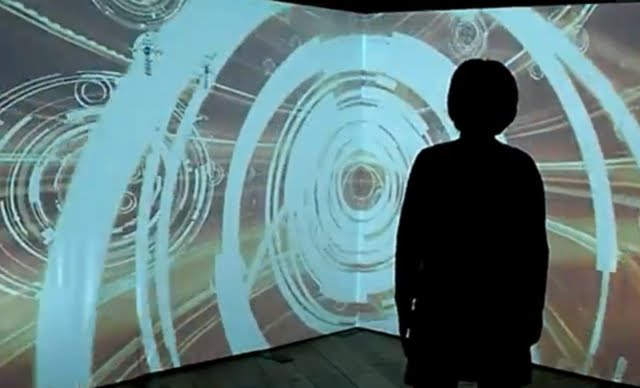
A new age in interactive technology takes you directly into the world of anime.
Celebrating the 3D re-release of "Ghost in the Shell: Stand Alone Complex Solid State Society" (ph9.jp/) from March 26, Kayac Inc. has created a special promotional booth that places you right inside cyberspace.
Using Microsoft's Kinect Sensor visitors can interact with the virtual anime landscape in the Cyberspace System using just body gestures and movement. Your mission: Locate and capture the Tachikoma character in the cyberspace. Be warned, you only have a limited time!
No joysticks, no controllers, no buttons…Float freely through cyberspace just by twisting your body to turn, leaning forward or back to shift perspective, and placing one step in front or behind to move. You can finally "capture" the Tachikoma by sweeping down with one arm.
Try the experience for yourself at the S.A.C. Premium Shop inside monozoku, on the fifth floor of Parco department store in Shibuya, from March 24th to April 19th. It's harder than it looks!
A new touchscreen interface by stereolize. Since we are renowned for technological innovations that we try to top year after year after year we also came up with something awe-inspiring this year. The largest touch display in the world. 234" of pure interactivity!!! You can probably call it the world´s biggest mobile phone touch display. See Video
Viewing media on a multitouch tablet is great, but what if you want to share it? KonnectUs by SENSUS combined with Open Exhibits makes sharing digital assets on your network simple. Creating shared experiences across multiple devices and multiple platforms has never been easier.
The Toshiba 14" USB-powered Mobile LCD Monitor is ideal for adding an additional screen to any Windows-based laptop at work, school, home or anywhere one uses a laptop. Featuring a 14-inch diagonal widescreen display with up to 1366x768 HD resolution, the Toshiba Mobile Monitor is equipped with the same LCD panel as a laptop to provide clear and crisp images. Weighing around 2.8lbs and less than one inch thick, this ultra-portable monitor is designed to fit in most laptop bags. The monitor's power and video are both powered via USB, eliminating the need to carry an AC adapter or video cable. The Mobile Monitor allows traveling businesspeople and students to conduct on-the-spot presentations and share content without the need for a bulky projector or having to crowd around a laptop screen. It can also be used as an additional screen in extended mode for serious home and on-the-go multitasking. The Mobile Monitor includes a protective black vinyl carrying case, which quickly folds into an adjustable stand that can be set to various viewing levels and also deftly houses the monitor's included USB Y cable.
One of two corporate trade show videos done for Evatran, a company developing plugless proximity chargers for electric automobiles. All original concept, graphics, 3d modeling, production, and post production by Carter Media.
Volvo Cars has been testing their C30 Electric In temperatures down to -33°C. Even though extreme cold can be a particular challenge for electric cars, the Volvo C30 Electric has no problems coping with the climate.
This is a voice-activated robot that automatically detects the food on your plate and feeds you your desired dish. This could be useful to all the people who are unable to feed themselves for one reason or another (e.g. due to accident or illness.)
In its 15.6" chassis it sports a full HD display with 1920×1080 resolution and a LED backlight screen. Under the hood we've got a 500GB 7200rpm HDD, 4GB of RAM and NVIDIA GeForce GT550M/ 2GB VRAM with Optimus technology. Taking a look around the unit, you'll find a DVD burner, two USB 3.0 ports, HDMI, and THX Tru Studio Pro technology in its 4 speakers and 1 subwoofer. It's not often you'll find such a large machine with only two USB ports, but they are 3.0, so they'll be super fast. Distributed by Tubemogul.
The EVO line continues! Aaron gets some hands-on time with the HTC EVO 3D, a new device announced at CTIA 2011 in Orlando. It's rocking a 1.2 GHz dual-core Snapdragon processor, 4.3-inch stereoscopic display (though it's long and narrow), dual 5-megapixel cameras for 3D video capture, front-facing camera, and Android 2.3 (Gingerbread) with the newest version of HTC Sense. It's coming this summer, and is an absolutely awesome phone with a killer specifications list, but the question remains - will 3D mobile content take off?
Campagna Motors builds its line of three-wheelers by hand in Montreal, Quebec (what is it about Quebec and three-wheelers; there's the Can-Am Spyder, too). The chassis of the T-Rex is constructed from 1.5-inch tubular steel and then covered in fiberglass body panels. This three-wheeler utilizes a double-wishbone suspension at each front wheel and a traditional motorcycle-style swingarm in the rear. Mounted behind the driver and passenger is a 197-hp, 1,352cc inline-4 engine and six-speed sequential manual transmission lifted from the Kawasaki Ninja ZX-14 — one of the quickest and most powerful motorcycles made today.
The iPad 2 is out and has been a major success for Apple, even with a few concerns with the extra heat the ultra thin tablet generates and the fact that some users are experiencing some issues with light bleeding from around the edges of the LCD screen.
But these rather minor issues are no where near enough to quash the mighty rumor mill that Apple has pulsating around it.
According to some sources close to the mighty granny smith corporation Apple will be launching a new iPad as early as September this year!
Bill takes apart an LCD monitor and shows how it works. He explains how it uses liquid crystals, thin film transistors and polarizers to display information.
Pratt & Whitney Rocketdyne has completed a series of hot-fire tests of the 52,000-54,000lb-thrust Bantam demonstration engine for a"pusher" launch abort system on Boeing's CST-100 spacecraft, under design for NASA's Commercial Crew Development program. The motor "pushes" the spacecraft to safety if a launch is aborted. The tests were conducted in the California desert.
NAVI (Navigational Aids for the Visually Impaired) is a student project aiming at improving indoor navigation for visually impaired by leveraging the Microsoft Kinect camera, a vibrotactile waistbelt and markers from the AR-Toolkit. While the "white cane" is a good tool to improve navigation for visually impaired, it has certain drawbacks such as a small radius or that it just detects objects that are on the ground (during typical use). We wanted to augment the visually impaired person's impression of a room or building by providing vibro-tactile feedback that reproduces the room's layout. For this, depth information from the Kinect is mapped by our software onto three pairs of Arduino LilyPad vibration motors located at the left, center and right of the waist. These pairs of vibration motors are hot glued into a fabric waist belt and connected to an Arduino 2009 board. To increase the impact of the vibration motor they were put into the cap of a plastic bottle. The Arduino in the waist belt is connected via usb to a laptop that was mounted onto a special backpack-construction, which has holes for cables and fan. To support point-to-point navigation usually a seeing-eye dog is used. This dog however must be trained for certain routes, costs a lot of money and gets tired soon. In certain research projects GPS is used to provide this point-to-point navigation, however GPS is not applicable for indoor scenarios. We wanted to utilize the rgb camera of the Kinect, so we put several markers of the AR-Toolkit on the walls and doors of our building thereby modeling a certain route from one room to another. The markers are tracked continuously all along the way and our software provides synthesized auditory navigation instructions for the person. These navigation instructions vary based on the distance of the person to the marker (which we get from Kinect's depth camera). So for example, if you walk towards a door the output will be "Door ahead in 3", "2", "1", "pull the door" where each part of the information depends on the distance to the marker on the door.
Rolls-Royce Motor Cars CEO, Torsten Müller-Ötvös, reveals 102EX, Phantom Experimental Electric. Andrew Martin, 102EX Chief Engineer, discusses the concept and looks closer at some of the technology that lies beneath the Phantom's powerful exterior.
This innovative knife from custom knife-maker John Kubasek is about the size of a credit card, and folds out. The actual blade is made from a laminate of real carbon fiber and steel, with a titanium handle. There is a clip on the back that lets you hold a few cards and bills.
A revolutionary breakthrough in flashlight technology. Designed for optimum light output, the new MAGLITE® XL100™ LED flashlight delivers user-friendly, performance oriented features in a sleek, tactical design. Engineered from the ground up, this advanced lighting instrument is driven by the next generation of MAG-LED® technology and includes the Advanced Flashlight User Interface™. The XL100™ flashlight features a push-button tail cap switch coupled with five selectable modes, plus variable strobe rates, intensity level memory recall and lockout (prevents accidental operation).